
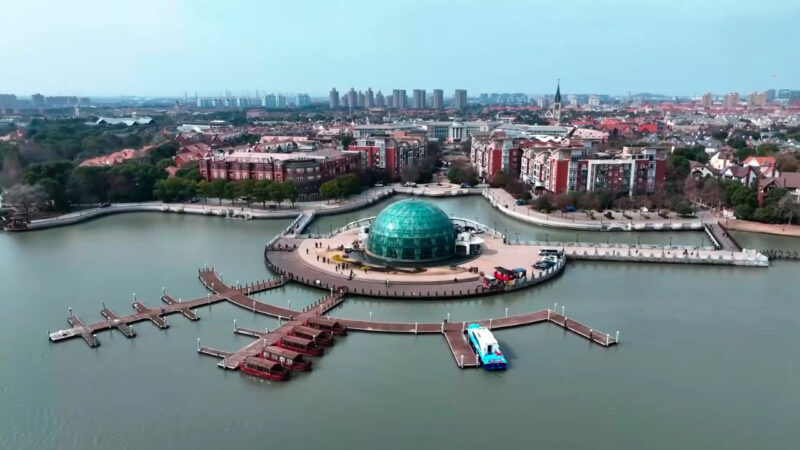
About 30 kilometers from central Shanghai, there’s a neighborhood where you can walk past Tudor-style houses, Victorian shopfronts, red telephone boxes, and a church that looks as though it belongs in the English countryside.
The streets have English names. There’s a statue of Winston Churchill. Even the cobblestones seem determined to convince visitors they’ve somehow ended up in Britain.
Except this is Thames Town, in Shanghai’s Songjiang District, and the buildings were constructed in the 2000s.
The most interesting thing about Thames Town isn’t that China built an imitation English village. It’s what people decided to do with it.
Developers intended it to become an attractive residential community. Instead, its early years brought reports of empty streets, expensive houses, and struggling businesses.
Meanwhile, couples began arriving with photographers, elaborate wedding dresses, and entire crews dedicated to producing the perfect romantic portrait.
Somehow, a residential development inspired by rural England became one of Shanghai’s recognizable wedding photography destinations.
Why Shanghai Wanted an English Town
Thames Town was part of a much larger experiment in urban planning.
In 2001, Shanghai launched an initiative called One City, Nine Towns. The idea was to create attractive suburban communities that would encourage people to move away from the increasingly crowded city center.
Rather than constructing identical residential districts, planners gave several developments distinctive architectural identities.
Different towns borrowed inspiration from Germany, Italy, the Netherlands, Scandinavia, and other places. Songjiang received an English theme.
The British engineering and design firm Atkins helped plan the development, which opened in 2006. Thames Town occupied roughly one square kilometer and was designed to accommodate approximately 10,000 people.
As a residential experiment, the concept wasn’t entirely unreasonable. Shanghai was expanding rapidly, and people needed housing outside its congested central districts.
But I find the choice of architecture fascinating. Instead of creating another collection of anonymous apartment towers, the developers tried to sell an entire atmosphere.
They weren’t offering buyers a house that merely happened to have brick walls. In fact, they were offering an imagined version of English village life. And that required considerably more than a few convincing facades.
They Didn’t Just Borrow the English Style
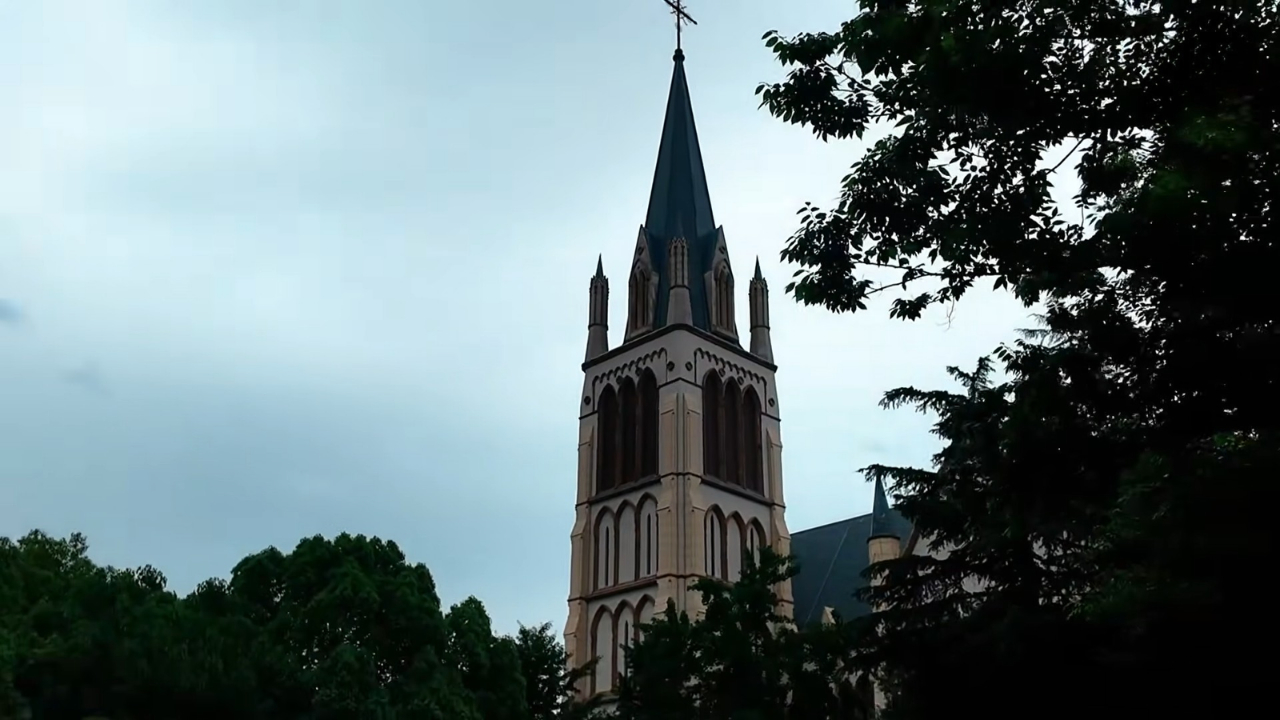
Thames Town contains a curious mixture of British architectural periods. There are half-timbered Tudor-style buildings, Georgian-inspired terraces, Victorian-looking commercial streets, and a large Gothic-style church.
The church was modeled on Christ Church in Clifton, Bristol. Other buildings reproduced recognizable features of existing English properties.
Two particularly unusual examples were inspired by a pub and fish-and-chip shop in Lyme Regis, Dorset.
According to NPR’s original 2006 reporting, the copied buildings even carried the names Rock Point Inn and Cob Gate Fish Bar, causing a controversy when people in Britain discovered them.
I can understand why the original business owners weren’t especially thrilled.
Borrowing an architectural style is one thing. Finding an imitation of your actual shop thousands of miles away is rather different. Still, the result is visually impressive in places.
Thames Town has recognizable streetscapes rather than just individual monuments. Its buildings form squares, narrow lanes, and public spaces that give photographers a variety of backgrounds.
A replica telephone box might make an amusing souvenir photograph. An entire street of English-looking buildings can create the illusion of being somewhere else altogether.
And for wedding photography, that illusion is remarkably useful.
The Wedding Photographers Arrived Almost Immediately
View this post on Instagram
One detail often disappears from accounts of Thames Town: couples were already taking wedding photographs there when it opened.
In December 2006, NPR correspondent Louisa Lim reported from the development and encountered a couple, Yang Jinghui and Zi Haiying, posing outside the church.
Both worked for major Western companies. They admired the surroundings but said they couldn’t afford to live in the expensive neighborhood.
They could, however, have their wedding photographs taken there. That small encounter captures something important about Thames Town.
Owning a European-style villa was beyond many people’s budgets. Spending an afternoon photographing yourself in front of one was much more accessible.
Wedding photography in China frequently involves elaborate pre-wedding portrait sessions, sometimes with multiple outfits and carefully selected locations.
The photographs aren’t necessarily taken during the wedding ceremony itself. They’re professionally staged images intended to capture the couple in romantic, elegant, or memorable settings.
Thames Town provides plenty of those.
A bride can pose outside the church, walk along an English-looking street, or stand beneath a decorative archway. The photographer gets different scenes without requiring an international trip.
A 2025 academic study of replica towns by Andrew Malcolm Law and Qianqian Qin documented the popularity of Thames Town among couples seeking Western-style wedding portraits.
The researchers also found that visitors associated the location with romance, escape, and the experience of temporarily being somewhere different.
I think that explains its appeal better than simply calling it a fake British village. People aren’t necessarily trying to convince anyone they actually got married in England.
They’re using the architecture to create photographs they like. And frankly, that’s a perfectly reasonable use for an unusual place.
Rome has its own romantic tradition. At the Trevi Fountain, visitors toss coins into the water with hopes of love or marriage, and the donations support local charities.
The Strange Difference Between Looking Successful and Being Successful
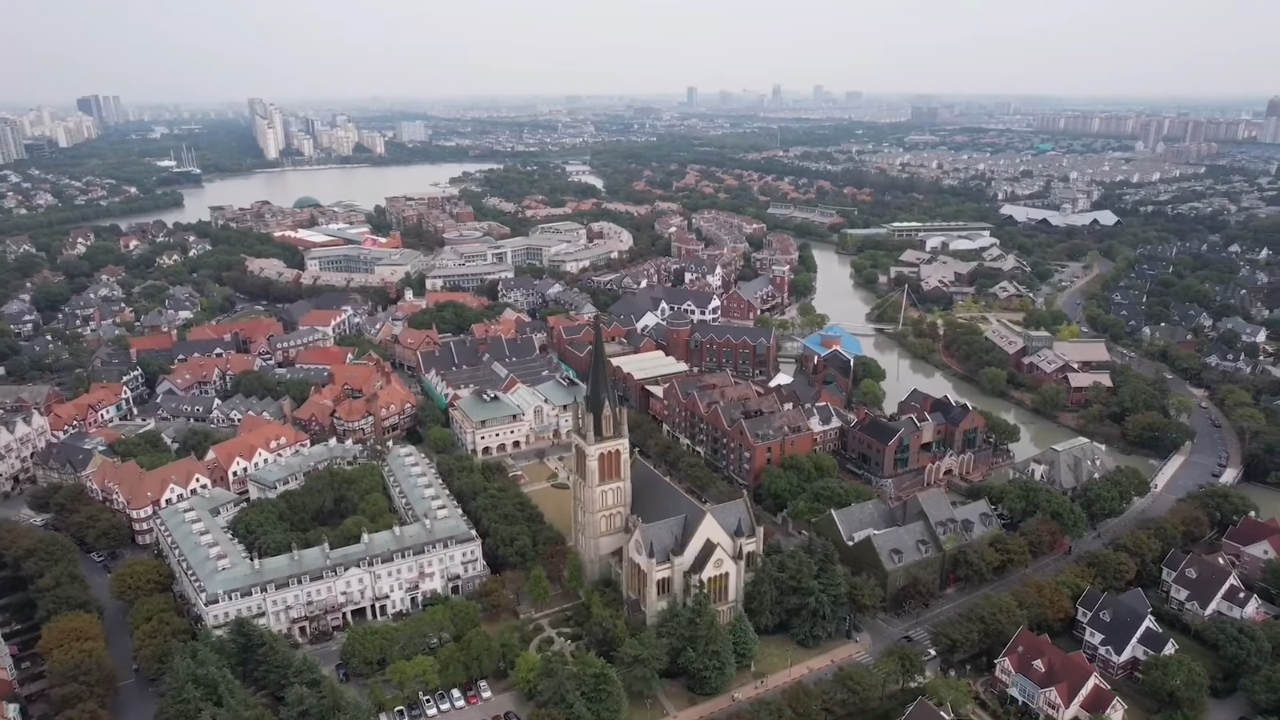
Thames Town’s popularity with photographers didn’t immediately translate into residential success.
Although many properties attracted buyers, high prices and investment purchases meant that relatively few people initially lived there permanently.
Empty storefronts contributed to its reputation as a ghost town. But that description needs some context.
Thames Town wasn’t an entire abandoned city. It was a residential development whose public commercial areas initially struggled to function as intended.
In fact, a Shanghai sustainable development report published through the United Nations documented 2,843 permanent residents and 221 stores, alongside gated residential communities.
The neighborhood had developed a life beyond its original publicity photographs.
This reminds me of China’s Paris-inspired development, Tianducheng, which also became famous for its European architecture and early reputation for emptiness.
Both developments reveal a problem with judging new places from photographs.
A beautiful street doesn’t tell you whether people can afford the housing, whether shops have enough customers, or whether residents can reach their jobs conveniently.
Those ordinary details matter much more than decorative architecture.
But Thames Town also illustrates something else: a place can acquire an identity its developers never completely anticipated.
Its public spaces found an audience among photographers, tourists, and leisure visitors even while its housing market followed a different trajectory.
What Thames Town Is Like Today
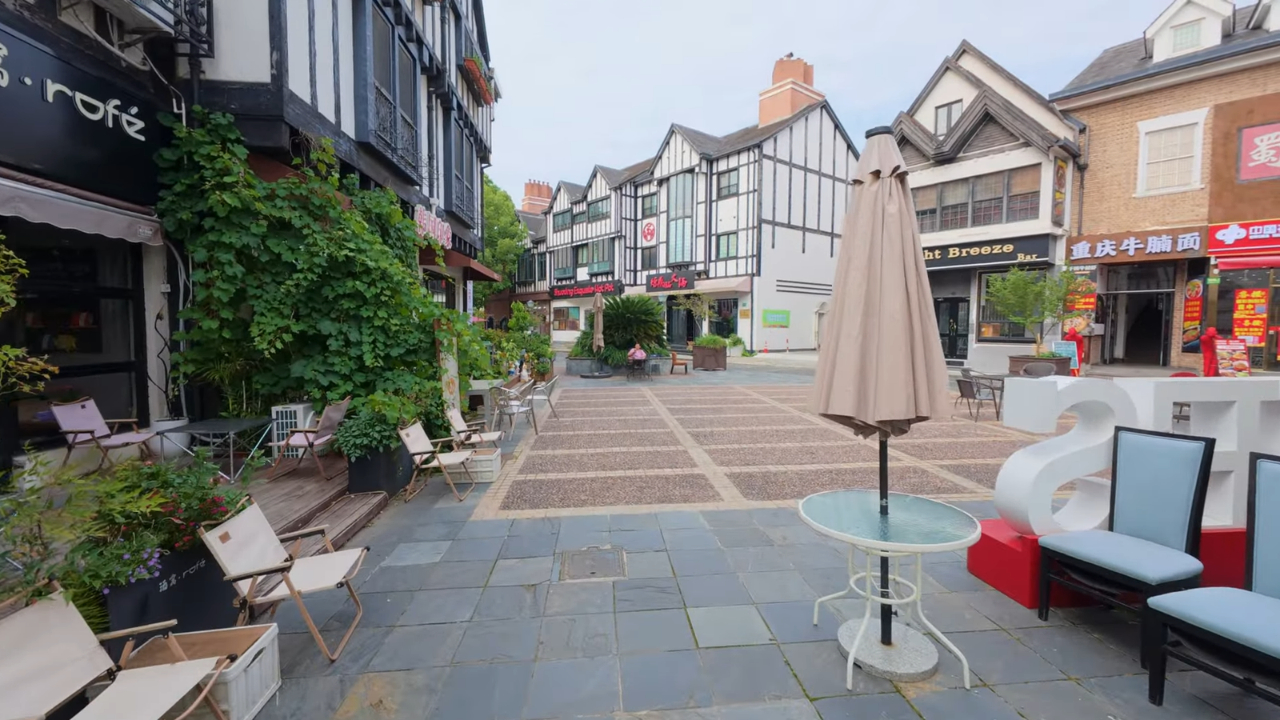
Thames Town is no longer adequately described by the old images of completely deserted streets.
It has residents, shops, cafés, cultural attractions, and visitors who come for reasons unrelated to buying property.
In a recent announcement from Songjiang authorities, Thames Town was recognized as a Shanghai Municipal Tourism and Leisure District.
The authorities highlighted its bookstore, art museum, church, lakeside scenery, and popularity as a filming and wedding photography location.
Zhongshuge Bookstore is another attraction worth knowing about. Its imaginative interior design makes it a destination in its own right.
The YOUNG Art Museum offers something beyond English architectural imitation.
And then there are the wedding photographers, still using the familiar streets as an elaborate outdoor studio.
I wouldn’t mistake the entire district for a lively traditional English market town. Its commercial and residential sections function differently, and some private housing areas are gated. But that’s part of its present character.
The place is simultaneously a residential neighborhood, a tourist attraction, and a collection of architectural backdrops. That’s a more interesting identity than simply being a copy.
Is Thames Town Worth Visiting?
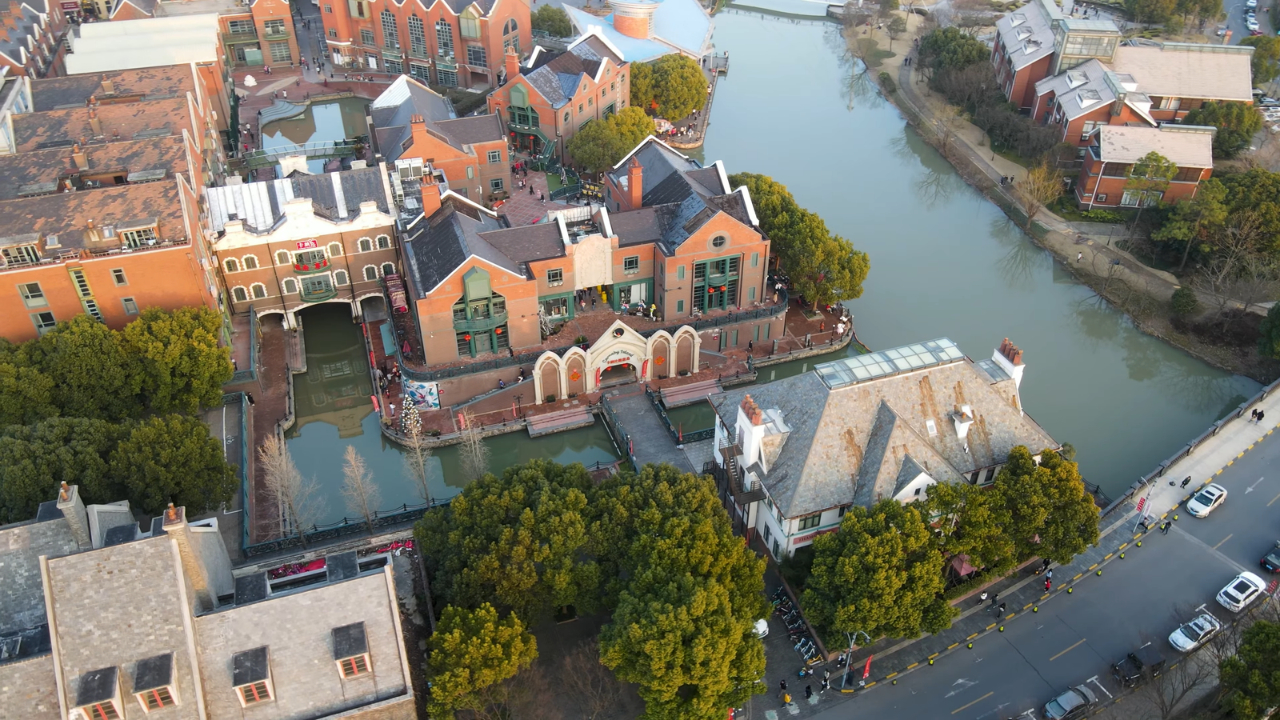
If you’re already spending time in Shanghai and enjoy unusual architecture, I think Thames Town is worth considering as a half-day excursion.
I wouldn’t travel to China specifically to experience imitation England. There are more compelling reasons to visit Shanghai.
But as an example of how ambitious urban planning can develop in unexpected ways, Thames Town is genuinely interesting.
A few details are worth remembering:
| What to know | Details |
| Location | Songjiang District, roughly 30 km from central Shanghai |
| Admission | Public streets are generally free to enter |
| Getting there | Metro Line 9 to Songjiang University Town, followed by local transport |
| Time needed | Allow approximately 2–3 hours for a relaxed visit |
| Main attractions | Church square, English-style streets, Zhongshuge Bookstore, YOUNG Art Museum |
| Best approach | Visit on a weekday if you prefer quieter photographs |
Visitor transport information also lists Songjiang Tram Line T2 to Thames Town West as an option, although checking current services before setting out is sensible.
I’d concentrate on the public streets and the church area rather than trying to inspect the residential properties. People live here, and their homes aren’t part of a museum.
Also, don’t expect an ordinary English town’s everyday atmosphere. Thames Town’s appeal is its interpretation of Britain, not a convincing reproduction of British daily life.
Can You Copy a Place Without Copying Its History?
China has experimented with European-inspired architecture in several other developments. Near Huizhou, developers constructed a replica of Austria’s Hallstatt, reproducing recognizable elements of the original lakeside village.
In Washington State, meanwhile, Leavenworth transformed itself into a Bavarian town to attract tourists and revive its economy. These places raise an interesting question about what makes architecture meaningful.
An English market town might have evolved over hundreds of years around agriculture, trade, religion, and local industry.
Thames Town borrowed the appearance without that history. Yet the people visiting it have begun creating memories of their own.
By contrast, the reconstruction of Shuri Castle in Japan aims to preserve the architectural heritage of the former Ryukyu Kingdom after the devastating 2019 fire.
@haroldchenjt Let me show you Thames Town in Shanghai, China #shanghai #china #british #thames #town ♬ Golden Brown (Slowed Down Version) – The Stranglers
Couples have wedding albums featuring those streets. Residents have established homes there. People meet friends at cafés and spend weekends walking around its public spaces.
None of that makes Thames Town authentically English. But perhaps it doesn’t need to be.
What interests me most is that the developers planned an idealized English community, while visitors found their own reasons to use it.
They didn’t need the place to be an authentic piece of Britain. They needed somewhere beautiful to take photographs.
And after two decades, those wedding portraits have become part of Thames Town’s own history.