
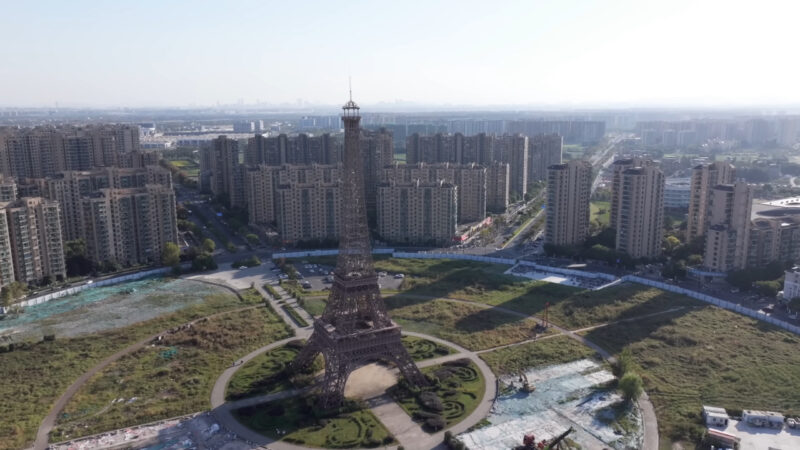
China has its own Eiffel Tower, a Champs-Élysées-inspired boulevard, and entire streets of Parisian-style apartment buildings. They’re not in a theme park.
They’re part of Tianducheng, a residential development on the outskirts of Hangzhou that was once considered one of China’s most spectacular urban failures.
When construction began in 2007, developers imagined an attractive European-style neighborhood where thousands of people would live.
Instead, the apartments struggled to attract residents, and photographs of the deserted French architecture earned Tianducheng the nickname “ghost town.”
The interesting part is what happened afterward. People eventually moved in. Businesses appeared, transport connections improved, and the supposedly abandoned development started functioning as an ordinary residential community.
I find that considerably more interesting than the miniature Eiffel Tower. Anyone with enough money can construct a convincing imitation of a famous landmark. Creating a neighborhood where people actually want to live is a different challenge.
Building a Little Paris Outside Hangzhou
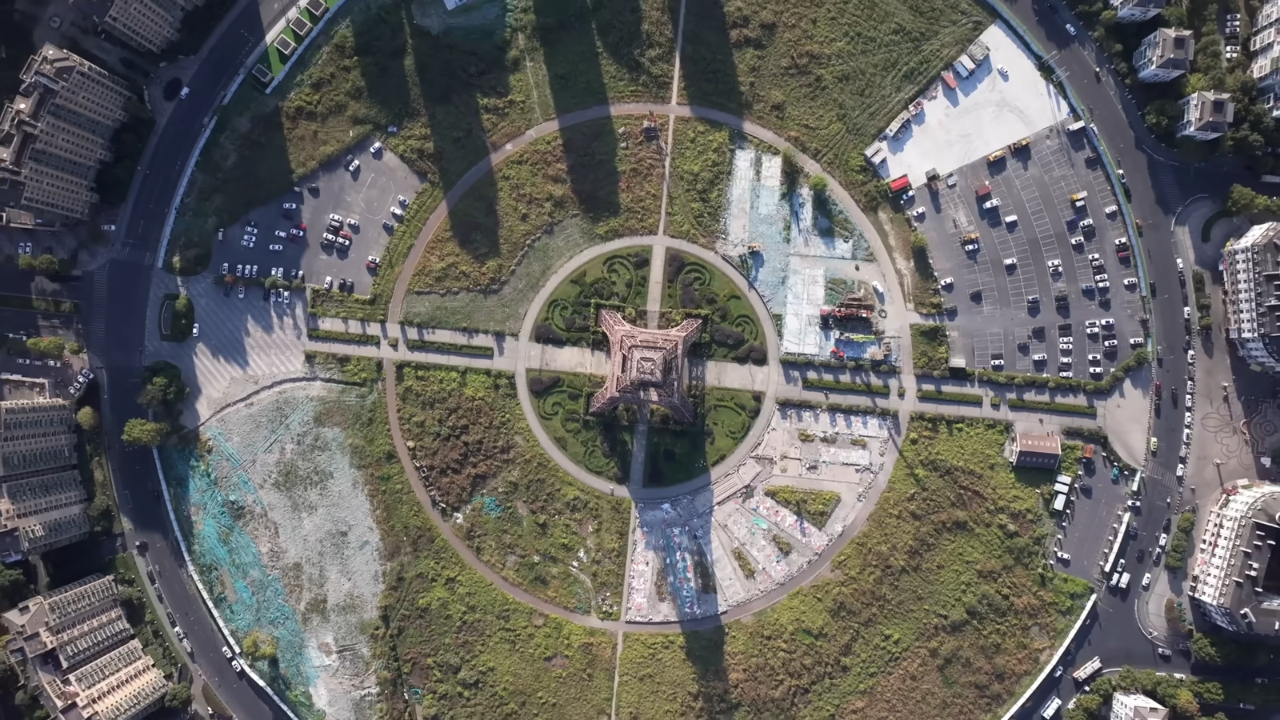
Tianducheng, officially known as Guangsha Tianducheng, sits in the Linping District of Hangzhou, the capital of China’s Zhejiang Province.
Its most recognizable feature is a 108-meter replica of the Eiffel Tower, approximately one-third the height of the Paris original.
But the developers didn’t stop at a single monument. They constructed an entire French-inspired residential environment, borrowing some of Paris’s most recognizable architectural features:
- Champs-Élysées-style avenues: Broad roads lined with European-looking apartment buildings.
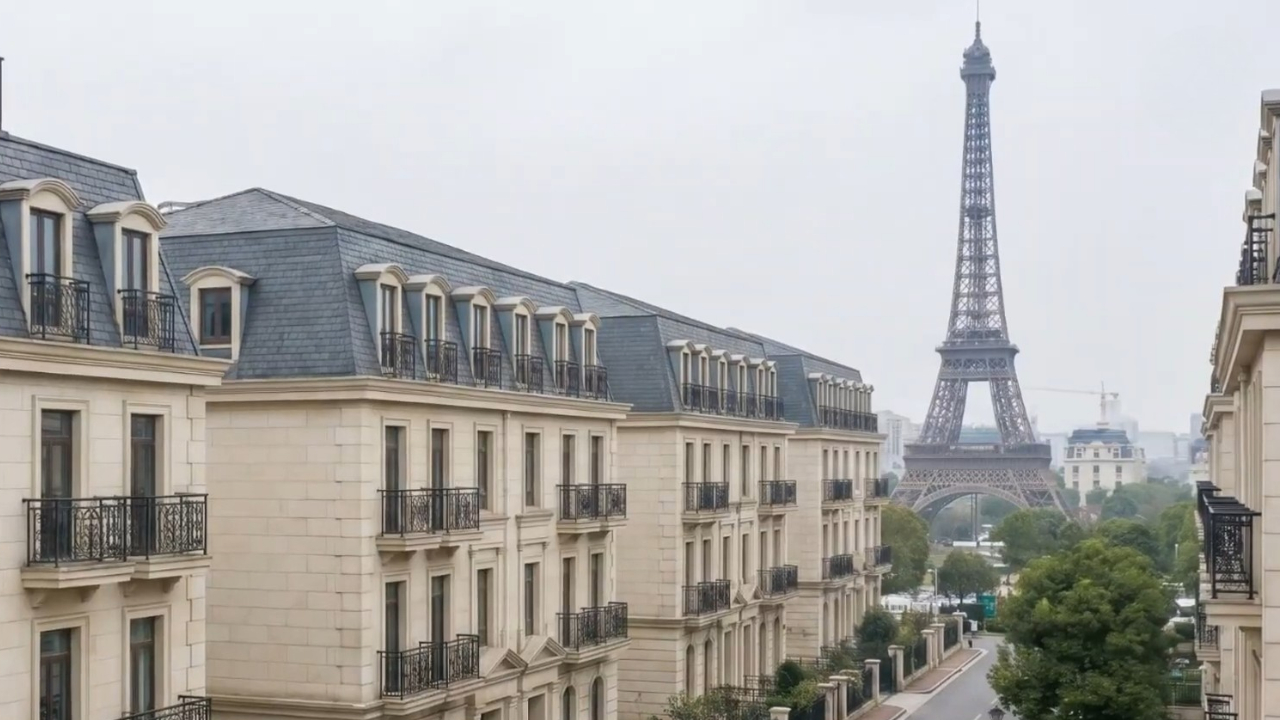
- French neoclassical architecture: Pale facades, mansard roofs, decorative balconies, and symmetrical designs.
- Formal gardens and fountains: Landscaped public spaces inspired by locations such as Luxembourg Gardens and Versailles.
- Parisian landmarks: Recreations of recognizable monuments, including an Arc de Triomphe-inspired structure.
In a 2018 National Geographic photographic feature, French photographer François Prost documented the extraordinary similarities between Tianducheng and Paris by comparing their architecture.
Some photographs are surprisingly convincing. Others reveal enormous Chinese apartment towers rising behind the French-style streets.
Personally, I rather like that contrast. It’s more interesting than a completely faithful reproduction would have been.
The development was never intended to become an independent French city. It was a commercial housing project designed to attract buyers interested in European architecture and an upscale residential environment.
Early descriptions suggested accommodation for at least 10,000 people, while larger development plans envisioned considerably more.
There was just one problem. Building the apartments turned out to be much easier than filling them.
Why China’s Paris Became a Ghost Town
By 2013, Tianducheng had acquired an unfortunate international reputation. Contemporary estimates suggested approximately 2,000 residents, far fewer than originally anticipated.
The architecture wasn’t necessarily the problem. The location was.
Tianducheng stood far from central Hangzhou, with inconvenient transport connections and limited nearby employment opportunities.
A Lincoln Institute research paper examining Chinese copycat towns described these problems in detail. During fieldwork in 2016, a researcher found that traveling from Hangzhou Railway Station to Tianducheng by public transport took roughly two hours.
The research also identified financial difficulties, incomplete construction, and inadequate infrastructure.
The Problems Behind the Empty Streets
| Early problem | Why it mattered |
| Remote location | Residents faced long journeys to central Hangzhou. |
| Poor transport connections | Daily commuting was inconvenient without reliable public transport. |
| Incomplete development | Some promised facilities and infrastructure were never finished. |
| Limited public services | The neighborhood lacked conveniences that attract permanent residents. |
I’ve always thought transport tells you more about a developing town than its promotional photographs.
You can advertise fountains, balconies, and beautifully landscaped streets. But residents still need to reach their workplaces, buy groceries, take children to school, and get home without spending half their day traveling.
The photographs of Tianducheng weren’t necessarily misleading. They captured a development that hadn’t yet become the community its developers envisioned.
The People Who Moved In Had Their Own Reasons
Not everyone regarded Tianducheng as a failure. In a 2016 ABC News report, one resident explained that she lived there because housing was relatively inexpensive compared with central Hangzhou.
She also appreciated the environment for raising her baby. Interestingly, she wasn’t particularly impressed by the replica Eiffel Tower. That small detail says quite a lot.
Foreign visitors tend to approach Tianducheng as an architectural curiosity. Residents have much more ordinary priorities.
The same contrast exists at Matmata’s underground houses in Tunisia. Tourists admire the unusual architecture, but local families developed the homes to cope with desert temperatures.
A similar distinction exists in Coober Pedy, South Australia. Tourists come to see its unusual underground houses. Residents live in them because they provide relief from the desert heat.
An affordable apartment, a suitable environment for children, and sufficient space can matter far more than whether the neighborhood resembles Paris.
As Hangzhou expanded, the previously isolated development gradually became more attractive.
Reports from the late 2010s placed Tianducheng’s population at around 30,000, although published figures vary depending on the area being counted. A reliable, current population figure specifically for the development is difficult to establish.
What is clear is that the community grew substantially beyond its early occupancy levels.
And a particularly important improvement arrived in 2022.
A Metro Station Changed the Equation
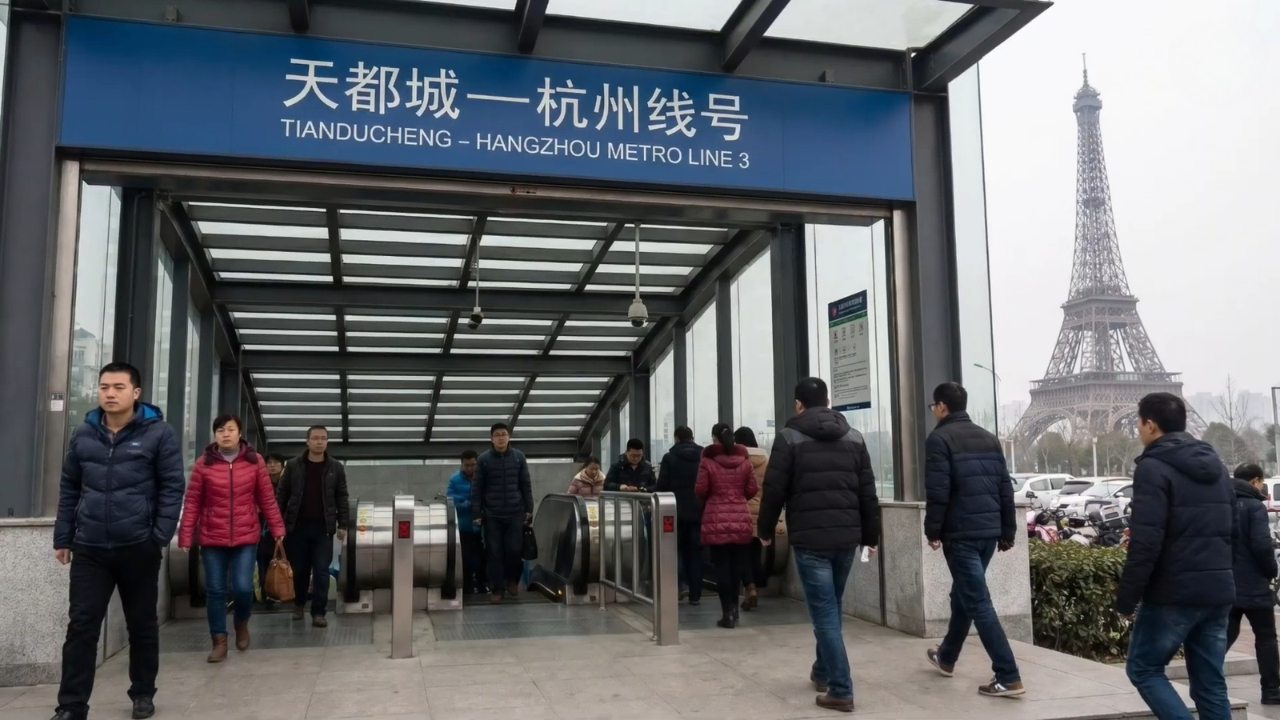
Hangzhou Metro Line 3 began serving Tianducheng in February 2022 through Huangheshan Station.
The station had originally been planned under the name Tianducheng before receiving its final name. Local reporting on the metro plans documented that change in December 2021.
This wasn’t nearly as photogenic as the Eiffel Tower, but I would argue it was more useful.
Direct access to an urban rail network makes an enormous difference to a residential development. Residents can reach other parts of Hangzhou without relying entirely on cars or slow bus journeys, while visitors gain a more convenient way to explore the area.
Of course, a metro station doesn’t automatically solve every problem. Employment, schools, shops, maintenance, and property management remain important.
Still, it removes one of the most obvious obstacles that discouraged early residents.
How Tianducheng Changed Over Time
- 2007: Construction begins on the French-inspired residential community.
- 2013: Reports of low occupancy attract international attention.
- Late 2010s: Population estimates rise substantially as more residents arrive.
- 2022: Huangheshan Station opens on Hangzhou Metro Line 3.
- 2026: Tianducheng is an established residential neighborhood, although some properties remain vacant.
The city had changed. Its reputation hadn’t quite caught up.
Not Quite Paris, but No Longer Abandoned
View this post on Instagram
Tianducheng continues to attract photographers, tourists, and couples seeking unusual wedding photographs.
Its imitation French landmarks are still the main attraction for outsiders.
But recent reporting tells a more complicated story than the familiar ghost-town headlines.
A May 2026 National Geographic article described a development with several thousand inhabitants, continuing residential occupancy, and a regular flow of visitors. It also acknowledged that many properties remained empty.
I think the original ghost-town narrative became popular partly because the photographs were so irresistible. An empty Eiffel Tower surrounded by Chinese apartment buildings provides a more dramatic story than a neighborhood gradually finding residents.
But the available evidence points to a community that has grown, even if it hasn’t fulfilled every original ambition.
Whether the development justified its enormous investment is a separate question.
China Didn’t Stop at Paris
Tianducheng wasn’t an isolated architectural experiment. Chinese developers also built Thames Town near Shanghai, featuring English-style architecture, and a recreation of Austria’s Hallstatt in Guangdong Province.
The Chinese replica of Hallstatt was particularly controversial because developers reproduced the appearance of an actual Austrian village, surprising residents of the original.
View this post on Instagram
These developments are sometimes described using the term duplitecture, meaning architecture that reproduces recognizable buildings or styles from other places.
The phenomenon raises an interesting question: Does copying a city’s appearance create any of the qualities that make the original desirable?
Paris developed over centuries through political decisions, transportation networks, commerce, architecture, and the lives of millions of residents.
Tianducheng borrowed the visual results without inheriting that history. But I don’t think that automatically makes the development worthless.
Consider Leavenworth’s Bavarian transformation in Washington State. That American town deliberately adopted German Alpine architecture during the 1960s to revive its struggling economy.
Its borrowed appearance eventually became an important part of its local identity.
The circumstances were different, but the underlying lesson is similar: architecture can attract attention, while the activities and communities developing around it determine whether the place works.
China itself has become more cautious about architectural imitation. In 2020, national planning authorities issued guidance discouraging plagiarism and imitation in major public-building projects.
That doesn’t erase the existing replica developments. It does suggest that China’s architectural ambitions have been evolving.
Can You Visit China’s Copy of Paris?
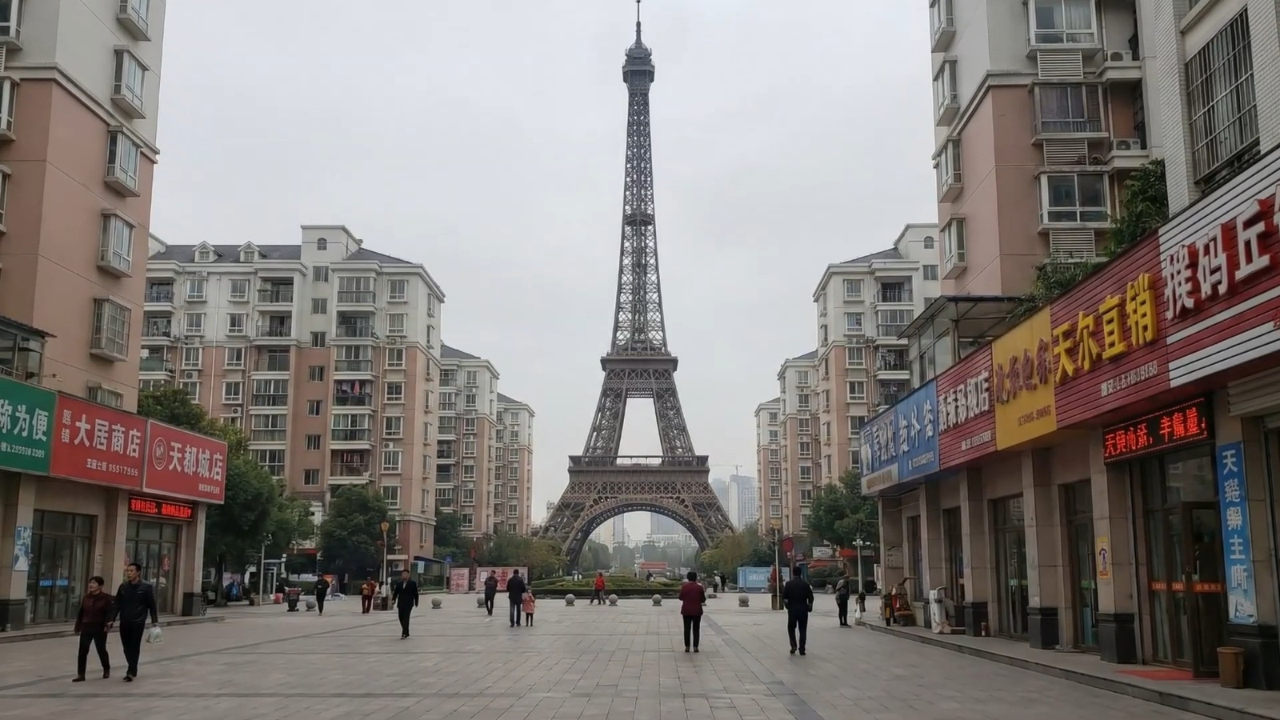
Yes. Tianducheng is in Hangzhou’s northeastern metropolitan area, and its French-inspired streets can be explored as part of a visit to the city.
The most useful transport option is Hangzhou Metro Line 3, using Huangheshan Station. From there, visitors can continue toward the Eiffel Tower replica and the surrounding streets.
What to Know Before Visiting
- Getting there: Take Metro Line 3 to Huangheshan Station, then continue toward the French-style development.
- What to see: The Eiffel Tower replica, European-inspired apartment buildings, fountains, gardens, and decorative architecture.
- What to expect: An inhabited Chinese residential neighborhood rather than a complete reconstruction of Paris.
- Check accessibility: Some areas have undergone construction and redevelopment, so confirm current local access information before visiting specifically for the tower.
Tianducheng isn’t the Louvre, the Seine, or an entire French city center waiting around the corner.
I’d treat it as a worthwhile excursion for someone already exploring Hangzhou, particularly anyone interested in architecture or unusual urban development. I wouldn’t organize an entire trip to China around it.
And remember that people actually live here. Their apartment buildings aren’t abandoned movie sets, however convincing the older photographs might be.
The Most Interesting Part Was Never the Eiffel Tower
@countingcountries China built a FAKE PARIS #tianducheng #china ♬ original sound – Counting Countries
I still think building a miniature Paris in eastern China is an unusual idea. I’m not convinced the architecture itself made the project successful.
What interests me is that Tianducheng slowly became a real place despite its artificial beginnings.
The developers could build an Eiffel Tower in a few years. Building a functioning community took much longer.
And unlike the tower, that part couldn’t simply be copied from Paris.